Wade in the water
Wade in the water, children
Wade in the water
God’s gonna’ trouble the water
Except we get in the water, and it doesn’t seem to trouble us that the North American church is still segregated, that there is a Black and White Church, that we remain divided over American chattel slavery, that we’ve made no reparations, offered no explanations for providing theological cover and justification for colonialism, forced cultural assimilation, Christian nationalism, racism, prejudice, and bigotry.
We’ve given no account for the racialization of Jesus’ gospel that starts with our children’s ministry: “Jesus loves the little children/ all the children of the world/ red and yellow, black and white/ they’re all precious in his sight/ Jesus loves the little children of the world.” Except that’s not how Jesus loves the little children; that’s how we love them—according to race and the social coloring of skin since no one is physically colored red or yellow, black or white.
Yes, the Apostle Paul is right when he says to the church at Corinth: “For not all flesh is the same, but there is one kind for humans, another for animals, another for birds, and another for fish.”[i]
More so, we should repent for breaking the second commandment and framing it in our sanctuaries and homes, coloring in the face of God as if we could see the face of God and live.[ii] And somehow, we are convinced that Jesus looks so much like us, that he is made in our spitting image. Because if Jesus doesn’t look like us, then he cannot be our leader, right? But again, Paul tells the Corinthian believers: “From now on, therefore, we regard no one from a human point of view; even though we once knew Christ from a human point of view, we no longer know him in that way. So if anyone is in Christ, there is a new creation: everything old has passed away.”[iii] Baptized into his death, who we were is dead in the water.[iv]
Because baptism as expressed by the early church’s first creed eulogizes cultural rivalries, refuses to maintain hierarchical realities or to participate in gender wars: “For you are the children of God in the Spirit. There is no Jew or Greek; there is no slave or free; There is no male and female. For you are all one in the Spirit.”
Because we cannot get in the water and come up with an air of superiority or rise to look down our noses at anyone. But we should get in the water and come up asking ourselves, “What have I gotten myself into?”
Instead, we dry off and smile with a certificate of baptism in hand as though the work of regeneration is complete. But what of our inward orientation has changed? The songwriter said, “I told Jesus it would be alright if he changed my name.”
Saul becomes Paul, but what of your scale- eyed conversion? How do we know that you see people differently, that you are no longer a hater, a persecutor of marginalized communities? How do we know that you have renounced your belief in white supremacy? How do we know that you won’t weaponize your privilege? When and with whom has the water of baptism made a difference in your way of relating?
Did you have a vision like Peter, who before God intervened saw people as clean or unclean? Have you received his testimony, “I now realize how true it is that God does not show favoritism but accepts from every nation the one who fears him and does what is right. … Surely no one can stand in the way of their being baptized with water. They have received the Holy Spirit just as we have.”[v] The baptismal water caused trouble for Peter’s prejudices.
But today, persons quip, “You can go down a dry devil and come up a wet devil.” It speaks to the perceived ineffectiveness of the water of baptism to change the lives of Christ followers. Willie James Jennings redirects and teaches us in After Whiteness: An Education in Belonging: “Belonging must become the hermeneutic starting point from which we think the social, the political, the individual, the ecclesial, and most crucial for this work, the educational. Western education (and theological education) as it now exists works against a pedagogy of belonging.”[vi] “One Lord, one faith, one baptism, one God and (Parent) of all”[vii] what are we teaching if not that we belong to each other, that we are one with Christ, that we are all God’s children?
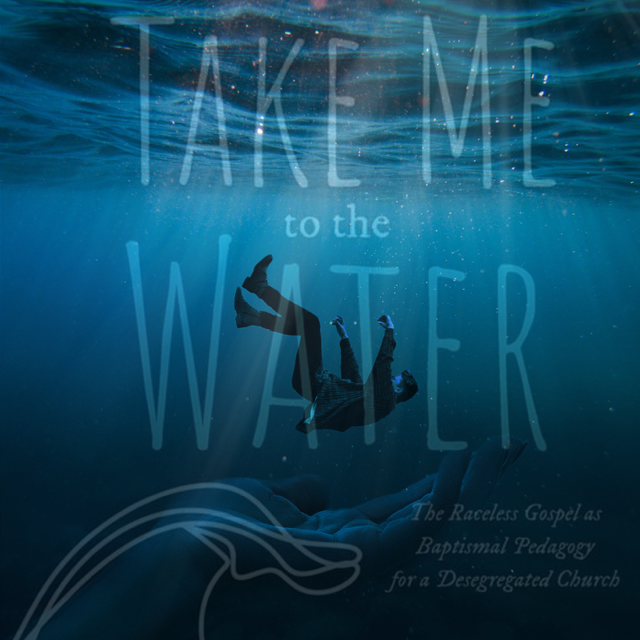
Because baptism was never meant to be reduced to a step towards church membership. Because we don’t join a church but a body of water. By immersing ourselves in the water, which is not to be confused with sticking our toe in the water, we die with Christ and to who we were along with the societal expectations of who we should be.
We are going to need a little more time in the water. I would argue that we wade in it until the issues of our day begin to trouble our souls and we deliver eulogies to what alienates us from ourselves and each other, that we cry out for freedom from competing and comparative identities because we are members of one another.
[i] First Corinthians 15:39, NRSV
[ii] John 1:18
[iii] Second Corinthians 5:16-17, NRSV
[iv] Romans 6:3, NRSV
[v] Acts 10: 34-35, 47, NRSV
[vi] Willie James Jennings, After Whiteness: An Education in Belonging, (Grand Rapids, MI: William B. Eerdmans Publishing Company, 2020), 10.
[vii] Ephesians 4:5-6, NRSV
 The Raceless Gospel