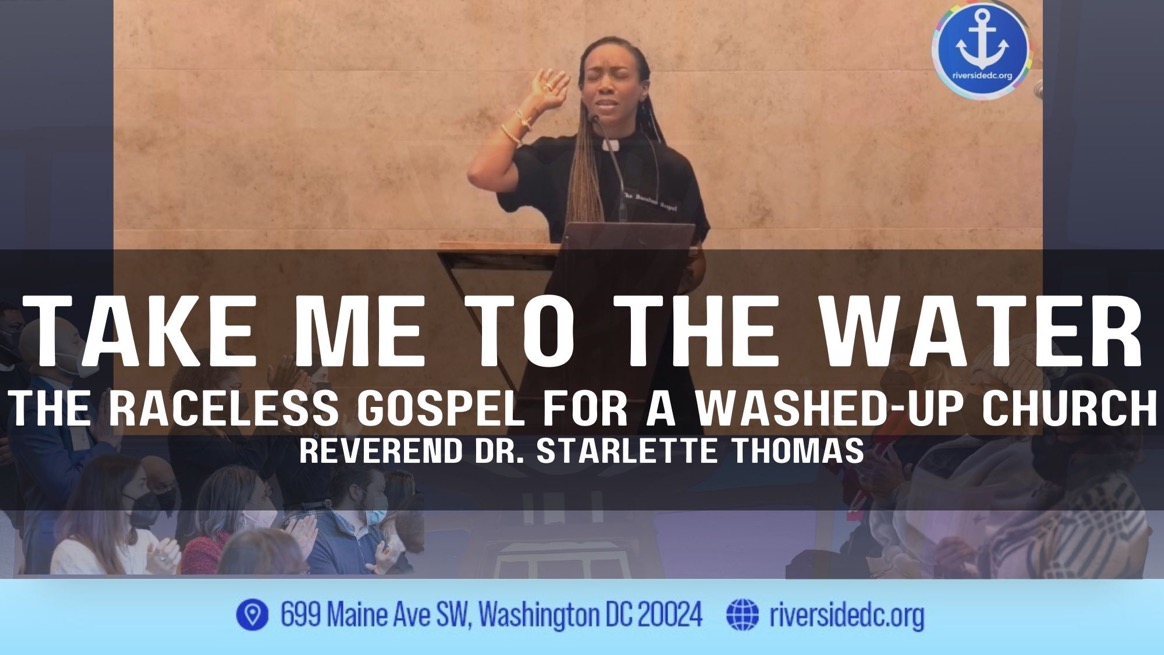
Starlette, a baptism evangelist and minor poet—sent to you neither by her own will nor human manipulations but by way of troubled waters, moved by the Spirit groaning due to a prolonged laboring for a new humanity, for a “kin-dom” that is coming.
Asking parenthetically, “Why aren’t we reborn yet? Why aren’t we there yet? Why haven’t we delivered on our promises of a new community and sacred space and divine fellowship? Why has the church become nothing more than rubbled monuments to the former, known for covering the same ground over and over again, nothing more than another capitalist enterprise that makes more changes during business meetings—than in our communities? Could it be because children practice piano more than we practice our faith?” Don’t answer that. I have digressed.
To the churches in North America:
I am no longer surprised by your desertion of Christ, who called us to his side and called us friends and called us siblings, which makes us next of kin. Still, you call me “everything but a child of God.”
Is this why I can’t call on you when injustices are happening, why I can’t talk to you about the world of hurt I’m in, why I can’t ask you to help me lift this crushing weight of white supremacy, this burden of patriarchy, this load of misogyny, why I shouldn’t expect you to be standing next to me when my liberties and humanity is under attack?
As a member of Christ’s body, members of one another, can’t you feel it too? Or is our connection just in my head, just on Sunday mornings, just between the segregated hours of 11 a.m. and noon?
If so, then I have this one thing against you—okay, maybe two. You have racialized the gospel of Jesus Christ and made whiteness the measure of humanity and divinity. This is “another gospel,” and it is heresy.
Because even if we figured we could climb a ladder or stand on each other’s shoulders until we reached the “highest heavens”[i] to sketch and paint in the face of God with a steady hand and plenty of paint,
even if we believed we could somehow chase and capture and measure and cut down the Divine to fit in 5×7 and 8×10 and 11×17 frames or even a canvas size—with no regard for the holy scraps left over,
even if we surmised that we could see God and live, it doesn’t change the fact that God is Spirit and moving around here, still speaking with many mouths—
from burning bush to still small voice,
to pestilence and divine intervention,
to dream states where a rock makes for a good pillow,
to big fish and reluctant prophets,
to a donkey,[ii] a raven and a widow and through a handful of flour and a little olive oil,
to water that blushes at the sight[iii] of its Creator as the Rev. Dr. Gardener Taylor described it,
to angels and women who burst out into song and to the babies they carried.
Even though we say God only speaks through men, scripture, our tradition, our singular experience and to people- tents who fit a socially constructed description of goodness and aesthetic righteousness, we are only pretending to speak for and contain the Holy.
So where are we going with all of this? Truly I tell you, if anyone proclaims a gospel that aims to make God in their own image, let them be accursed.[iv] Because our skin and its social coloring will not save us and to add this belief to Christianity is to support a tenet of white supremacy. Social meanings tucked neatly under epidermis; we are living superficially—not spiritually—though the waters of baptism call us to live from the depths of our being.
Furthermore, despite your lectionaries, litanies and Lenten journeys, which are treated more like a 40- day challenge and the appearance of an orderly church, your leadership is way out of line—following dollar signs and towing “the color line” and standing in line to take pictures with Caesar—instead of following Jesus. What are you smiling about? We have fallen so far behind.
Woe to the North American church that stands so close to people that Jesus wouldn’t be caught dead with and so distant from people he felt so connected to! To what is the body of Christ bearing witness to—when it is only carrying the water of the American empire?
It seems that we’ll have to start again at the beginning of Jesus’ ministry. So, I’m taking the church back to the water of baptism. Some of you will go kicking and screaming and holding tight to your belief that white is right, that race was with us “in the beginning” though it is a 17th century Enlightenment invention. Because it will mean your decentering and the drowning out of voices that only scream me and mine.
Some of you will deny that the gospel has been racialized all while teaching children to sing, “Jesus loves the little children/ all the children of the world/ red and yellow, black and white/ they’re all precious in his sight/ Jesus loves the little children of the world.”
Except this is not how Jesus loves them and we’ve got to figure out why we told children that he does, why we accommodated race, domesticated Jesus’ gospel, trained it to take up the least amount of time and space. We teach this song in Sunday School because it is easy to memorize but the hard truth is that in doing so, the gospel was racialized.
We don’t want to talk about race, but we sing about it. “Why is everything about race?” Because we made it so—when we made it a theology, when we mixed it in with hymns and added it to our Christology. When we painted in the face of God and colored in the body of Christ, we made race larger than the Creator of life. Walter Brueggemann teaches us, “Our sociology is predictably derived from, legitimated by and reflective of our theology.”[v]
In their book The Color of Christ: The Son of God and the Saga of Race in America, Edward J. Blum and Paul Harvey write,
“The white American Jesus first rose to power and prominence in the early nineteenth century. This was an era of the expansion of slavery and the often fraudulent and violent grabbing of Native American lands. It was also a moment of nation building and defining. Whiteness became a crucial symbol of national identity and citizenship. A new band of Protestants tried to win the young nation for Jesus by mass- producing and mass- distributing him. His racial affiliation, however, was soon embroiled in controversy. … The Civil War, emancipation, and radical Reconstruction fractured white national unity and cut the direct ties between whiteness and citizenship. This opened the door for challenges to the association of Jesus with whiteness.”[vi]
Oh, but how quickly we forget. We broke commandment number two and then framed it in our sanctuaries and homes. Because the Divine doesn’t come in our favorite color, but idols do. Because God is not made in our spitting image. No, it’s the other way around.
It is no wonder then why it is hard for us to keep the greatest commandment: “You shall love the Lord your God with all your heart, and with all your soul, and with all your mind.”[vii] Or the second that is just like it: “You shall love your neighbor as yourself.”[viii] Because we love people based on race and created a sing- along as part of our diversity training.[ix]
Because this is not how Jesus loves the little children. This is how the songwriter, C.H. Woolston said that Jesus loves the little children. This is his interpretation, his understanding of Jesus’ love for little human beings.
These are not Jesus’ words. This is not a scripture reading. This is a song, his song, his lyrics. This is not based on a single story in any of the four gospels.
This is an example of whitewashing. Whitewashing is defined as “deliberately attempting to conceal unpleasant or incriminating facts about (someone or something).” Woolston’s suggestion that Jesus agrees with the conclusions of race and loves us based on its categories is an example of whitewashing.
Rather than deal with the “unpleasant and incriminating facts” about the oppression that race creates, Woolston wrote a song that suggests that Jesus believes in race and accepts its imagined differences for human beings. The love of God then is not unconditional but color- coded.
The way we talk about race matters. Its purpose is to make one cultural group the solution by making another cultural group or groups the problem. See phrases like the “Negro problem,” the “Indian problem,” the “yellow peril” and current conversations about immigration and “the browning of America.” Race only functions in an us versus them relational dynamic. The racialized identity is inherently conflictual, both internally and externally.
Consequently, race needs to be redefined—not as a picture of a person but a projection of stereotypes and prejudices. Race is the problem with our relationships and communities—not other human beings. And this is how we must talk about it.
Albert Einstein is right: “We cannot solve problems by using the same kind of thinking we used when we created them.” Consequently, we must talk about race—not as a solution but the problem with how we identify ourselves as human beings.
It also unnecessarily complicates the unconditional love of God. It implies that Jesus loves us no matter our race. But that is not Jesus’ position. That’s not something that Jesus would say as a first century Galilean Jew and a child of God.
Because race teaches that God created human beings in comparison and that some human beings are better than others— innately, naturally, and spiritually. But there is no biological or biblical basis for this belief.
There are no scriptural references for race as the system of oppression based on the social coloring of skin did not exist during the time of Jesus or that of the children of Israel. While there were divisions, they were not based on race. Biblical scholar, Cain Hope Felder wrote in Race, Racism and the Biblical Narrative,
“In fact, the Bible contains no narratives in which the original intent was to negate the full humanity of (African) people or view (African) people in an unfavorable way. Such negative attitudes about (African people) and persons of direct African descent are entirely post- biblical.”[x]
He wrote in Troubling Biblical Waters: Race, Class and Family, “Today popular Christianity too easily assumes that modern ideas about race are traceable to the Bible… Centuries of European and Euro- American scholarship, along with a ‘save the heathen blacks’ missionary approach to Africans, have created these impressions.”[xi]
Woolston grouped the children according to colors— reds, yellows, blacks, and whites. But Jesus didn’t say a single word about race. He told his disciples to let the children come to him and not to get in the way.
But race gets in the way of how we see Jesus and hear his good news. It colors in his face to suit our tastes and for the satisfaction of white supremacy, he is remade in the image of a socially colored white, blonde haired and blue- eyed man. But that’s not Mary’s baby.[xii]
To listen to the full sermon, click here.
[i] Psalm 115:16
[ii] Numbers 22:21-39
[iii] This is how Rev. Dr. Gardener Taylor described the miracle of the water turning to wine.
[iv] This is an imitation of the opening of Paul’s letter to the Galatians 1:1-9.
[v] Walter Brueggemann, The Prophetic Imagination, (Minneapolis, MN: Fortress Press, 2001), 8.
[vi] Edward J. Blum & Paul Harvey, The Color of Christ: The Son of God and the Saga of Race in America, (Chapel Hill, NC: The University of North Carolina Press, 2012), 9,10.
[vii] Matthew 22.37, NRSV
[viii] Matthew 22.39, NRSV
[ix] This section is taken from a sermon I preached titled “Dead in the water.”
[x] Cain Hope Felder, Race, Racism and the Biblical Narrative, (Minneapolis, MN: Augsburg Press, 2002), 2.
[xi] Cain Hope Felder, Troubling the Biblical Waters: Race, Class and Family, (Maryknoll, NY: Orbis Books, 1993, Tenth Printing), 3.
[xii] A large portion of this section was pulled from my evening lecture to the members at Bethany Union in Chicago because it is currently 8:59 p.m. on Saturday.
 The Raceless Gospel