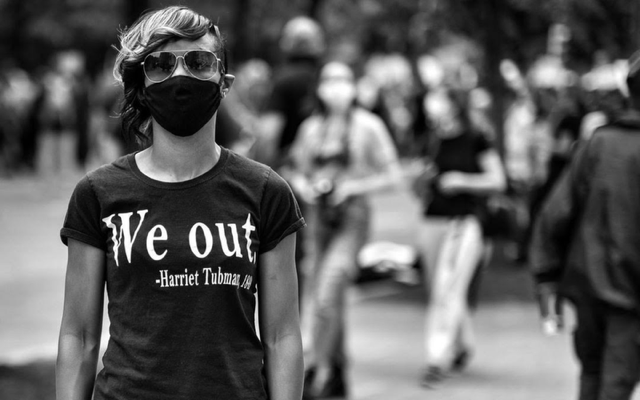
The Raceless Gospel is part proclamation, part embodied praxis. The integration of physical engagement with belief strengthens my conviction that we are all God’s children and race is not a genealogical indicator. Feet to pavement, I am convinced following Jesus doesn’t lead us to a church building but to bodies marginalized, racialized, hyper-surveilled and criminalized.
Were you there when George Zimmerman murdered Trayvon Martin? Did his screams cause you to tremble, tremble? If not, then all lives don’t matter.
But this has been true since America’s founding, since chattel slavery, as hundreds of years of dehumanization cannot be treated as water under the bridge. That water is the Middle Passage and we need to talk more seriously, more concretely, more specifically about race and its progeny as a practice of discipleship and spiritual formation.
We must talk more openly about the violence required of white-body supremacy and the very real threat of a “race war,” which its adherents believe is inevitable. Even if they must create the conditions and recast their neighbors as villains, the myth of American exceptionalism is worth it to them. Because the promise and privilege of social whiteness is domination, they want to go back to the country’s beginning and become owners of humans again.
African and African American bodies were treated as commodities, as “credit instruments,” as expendable once no longer profitable. This is a cornerstone of the country’s founding and the start of a credit-based economy.
African and African American bodies, racialized as black, used as collateral for mortgages and loans from the bank, ensured the South’s economic success. This is the root of capitalism: the commodification and exploitation of African and African American bodies.
Bodies treated as “usable raw material,” as “bulls” or “stock men,” as mammies and wetnurses, as a child’s plaything, as victims of non-consensual sexual exploitation and rape, as livestock, as three-fifths of a human being and soulless. Not persons but property, their bodies were used for public spectacle and medical experimentation, which continues today and is made evident in health disparities, police violence, systemic inequality and media representation. Post-slavery exploitation also continues, as there has been no resolve to stop it, resulting in “captive labor” for the prison industrial complex.
Additionally, we are still reading headlines of African American men found hanging from trees: Demartravion “Trey” Reed and eight others and African American women are still being used for medical experimentation. Adriana Smith was brain-dead but kept alive because she was nine weeks pregnant. “Oh, make me wanna’ holler/ the way they do my life,” Marvin Gaye sang in 1971, and I sing along because not much has changed.
I tell you this because we must speak truthfully about America. America’s hope is toxic because it requires an us-versus-them mentality, the masking of deep societal issues, the loss of a shared reality and future. But “nobody’s free until everybody’s free.”
Oriented toward lived reality, this daily integration is the witness needed for an oftentimes disembodied Christianity, which is too often associated with virtual worship services, resulting in a “digital drift.” However, we are so much more out of touch with each other than this.
Furthermore, this means the faith tradition is more often associated with a building than the body of Christ. We were supposed to behave as members of each other. Instead, our differences are noted as splits etched in stone buildings we name after our divisions— though trusted with a ministry of reconciliation (Second Corinthians 5:18-20). The church reduced to four walls tragically collapses its meaning.
Before I realized it was rubble, I was there from week to week, fully persuaded that sitting in a pew ensured my seat at the banquet table (Luke 14:15-24). But reservations had already been rescinded and excuses given for the lack of attendance. So, like my grandmother, Eva Mae, God was on the porch calling folks off the street into “the world house.”
Supper was ready. The welcome table was set and would-be guests were in the streets singing, “I’m going to sit at the welcome table/ Shout my troubles over/ Walk and talk with Jesus/ Tell God how you treat me/ One of these days!”
Now, one of these days feels like every day of the week as I take my seat on city streets and choose to place my cheek on the pavement. I most identify with those brutalized by police brutality.
An unfortunate parable, the murder of George Perry Floyd Jr. changed me. His cries and pleas made me leave my office suite on Sixteenth Street in northwest Washington, D.C., in the middle of a global pandemic.
I had to put my body on the line. I figure it’s the least I can do because he couldn’t breathe.
Perry’s death made me question my calling. “Preaching to the choir” immediately became unfulfilling. So, I followed Jesus out of the building and never looked back.
Preaching as lived experience was more appealing. No more monologues with intermittent call and response with the congregation.
Instead, I move according to the Spirit’s leading, an embodied homiletic for a people who have lost faith in white-body supremacy. My faith in a kin-dom coming has only increased.
Note: This op-ed was written for Good Faith Media and first appeared here.
 The Raceless Gospel