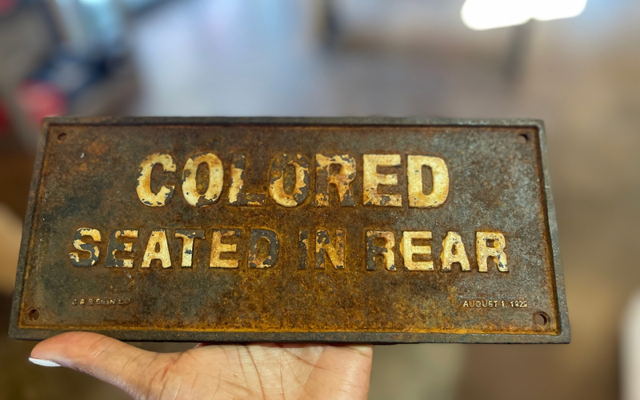
Woe to the North American church! A segregated fellowship, the Raceless Gospel calls this “whited sepulcher” to address the deadly sin of white-body supremacy, a reckoning hundreds of years in the making.
Because the church in North America must become a faithful and prophetic witness against the vocal and virulent voices of those who animate oppression and exclusion based on the racialization of skin to maintain the social privileges of “the people who believe they are white,” to employ the words of Ta-Nehisi Coates. It is equally important to name the violence a belief in supreme and subordinated bodies calls for.
“As for now, it must be said that the process of washing the disparate tribes white, the elevation of the belief in being white, was not achieved through wine tastings and ice cream socials, but rather through the pillaging of life, liberty, labor and land; through the flaying of backs; the chaining of limbs; the strangling of dissidents; the destruction of families; the rape of mothers; the sale of children; and various other acts meant, first and foremost, to deny you and me the right to secure and govern our own bodies,” Coates made plain in Between the World and Me.
Because too much has been said and done, resulting in the dehumanization, disembodiment, degradation and attempted disaffiliation of Africans and African Americans, racialized as black, from humanity, defined and systemically treated as less than to justify their exploitation, marginalization and subsequent denial of basic human rights.
Because while white supremacist theology is not named explicitly by the church’s leaders, it’s well-documented in sermons, hymns, catechisms, church and denominational splits, along with mission pamphlets that read like racist memorabilia. It’s long past time to answer for all of it and to offer a substantial series of corrective actions.
“American Christianity’s theological core has been thoroughly structured by an interest in protecting white supremacy,” Robert P. Jones concluded in White Too Long: The Legacy of White Supremacy in American Christianity. “While it may seem obvious to mainstream white Christians today that slavery, segregation, and overt declarations of white supremacy are antithetical to the teachings of Jesus, such a conviction is, in fact, recent and only partially conscious for most white American Christians and churches.”
Furthermore, Jones states, “The unsettling truth is that, for nearly all of American history, the Jesus conjured by most white congregations was not merely indifferent to the status quo of racial inequality; he demanded its defense and preservation as part of the natural, divinely ordained order of things.”
The Raceless Gospel is not to be confused, then, with a call to the ministry of reconciliation, which, in practice, often puts community before contrition, confession, social transformation and reparations. Instead, this is a calling out of the social and spiritual wickedness of this color-coded hierarchy for the hoarding of power, resources and opportunities as well as the violence of a theology of domination practiced in Christian community.
Moreover, merely asking for and offering forgiveness is insufficient and short-sighted, as historically, forgiveness has been weaponized against the victimized community, expected even before justice is rendered. This concept emerged in public discourse following the 2015 Mother Emanuel AME Church shooting carried out by Dylann Roof. The expectation of forgiveness was used to prematurely absolve American society of responsibility for systemic racism.
Calls for solidarity must also be reexamined. As pointed out by Alex Mikulich in Unlearning White Supremacy: A Spirituality for Racial Liberation, “White people and institutions often use the term ‘solidarity’ without taking the real risks involved in the emotional, spiritual, political and practical work of racial liberation.”
Consequently, the Raceless Gospel advocates for the divestment of whiteness and its privileges, the decentering of whiteness as normative, the default and the standard for human being and belonging, the decolonization of the Christian faith tradition, the desegregation of its church’s membership and the promotion of a non- colonial engagement and understanding of God and Christian Scripture while advocating for the realization of the “new humanity” evidenced by baptized believers for a coming “kin-dom.”
An early church creed, Galatians 3:27-28 is a worthy confession: “As many of you as were baptized into Christ have clothed yourselves with Christ. There is no longer Jew or Greek; there is no longer slave or free; there is no longer male and female, for all of you are one in Christ Jesus.”
This is a call back to the reality of the Christian’s baptismal identity and away from white-body supremacy’s delusions of domination through “relationships of ruling,” omnipotence and ownership of the world seemingly with God’s thumbs up of approval. It is finger snapping to break the hallucination that we are made in the image of colors and not our Creator.
The Raceless Gospel then is a proclamation of righteous judgment against these selective misanthropes or haters of human beings as determined in part by the writer of the first letter to the Johannine community: “Those who say, ‘I love God,’ and hate a brother or sister are liars, for those who do not love a brother or sister, whom they have seen, cannot love God, whom they have not seen” (4:20, NRSV). An inflexible position, this is where I stand and as the hymnwriter sang, “I shall not be moved.”
Note: This column, written for Good Faith Media, first appeared here.
 The Raceless Gospel