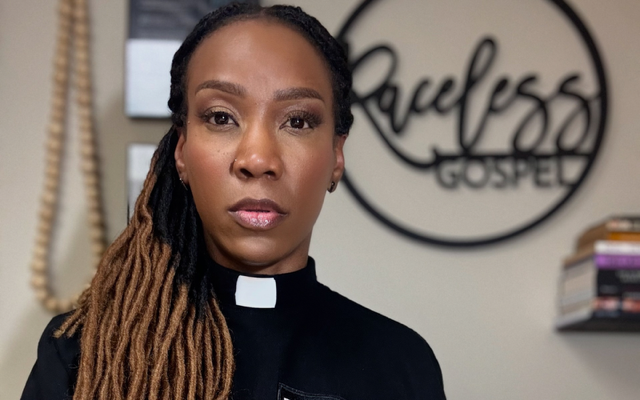
To whom do I address the message of the Raceless Gospel? No one in particular. I don’t have a target audience as this proclamation is for a world yet to be.
I know as much as I tell you. I am given one line at a time. Hook, line and sinker, I took the bait for a better world—even if I never live to see it.
It’s something like the Rev. Dr. Martin Luther King Jr.’s mountaintop experience. All I needed was a peek. Knowing that a kin-dom exists in another space and time was enough to get me going in the direction of what has become The Raceless Gospel Initiative.
I am talking to you though with the hope it becomes a part of your genealogy: The Raceless Gospel begat human beings who remembered there was only one kind of human. In his first letter, the Apostle Paul said it to the community at Corinth: “Not all flesh is alike, but there is one flesh for humans, another for animals, another for birds, and another for fish” (15:39, NRSV).
I read it once and was convinced, immediately delivered from white-body supremacy and the hierarchical way of seeing myself and others. I didn’t need a reminder as he made it as plain as a new day.
It just made sense—except when you’re bombarded by messages of feigned difference, except when you consider the violence that backs the belief system, the “racial contract.” Persons “who think of themselves as White,” as James Baldwin described racialization, will steal, sell, enslave, rape, lynch, target, surveil, incarcerate and deprive generations of humans of unpolluted land, water and air they don’t own.
So, it bears repeating as repetition is conditioning. “Not all flesh is alike, but there is one flesh for humans, another for animals, another for birds, and another for fish” (First Corinthians 15:39, NRSV).
Because America elected its first African American president and thought we were post- racial. Because Americans flooded the streets in protest of the gruesome murder of George Perry Floyd Jr. at the hands of then Minneapolis police officer Derek Chauvin. Companies made statements, created DEI programs and made pledges toward a “racial reckoning”—only for the majority of European Americans to elect a white supremacist for president.
But I am not surprised because I believe America’s history. The country has yet to prove itself trustworthy in its relationship with African Americans.
Still, people will ask me about hope. Frankly, I have none to give this present age.
I believe as the prophets and seers before me, as James Baldwin said plainly in Notes of a Native Son, “The people who think of themselves as White have the choice of becoming human or irrelevant.”
Baldwin continued: “Or—as they are, indeed, already, in all but actual fact: obsolete. For, if trouble don’t last always, as the Preacher tells us, neither does Power, and it is on the fact or the hope or the myth of Power that that identity which calls itself White has always seemed to depend.”
This is true despite what Frantz Fanon described as a kind of epidermalization of inferiority in Black Skin, White Masks. The Raceless Gospel is for a generation who refuses to let that damned superstition get under their skin, who would rather scrape their bodies raw and to the bone than to believe that some humans are gods and others are demons. That’s too much power to give anybody.
Hear ye! Hear ye! Be delivered from these false binaries of light and dark, civilized and heathen, marginalized and centered, human and alien—as we all belong here.
There is no other place for us to go and be fully human—save this earth, this dirt of which we are all made. There is only one place for us to return and it is beneath our feet.
We are all dirt bags, so to speak. Or as the Apostle Paul explained, “Not all flesh is alike, but there is one flesh for humans, another for animals, another for birds, and another for fish” (First Corinthians 15:39, NRSV).
I am aware that I am early, that we have yet to arrive at these conclusions as a species. But I am also a messenger sent to get ahead of things and to prepare for the change that’s coming. I bear witness to Sam Cooke’s crooning, “It’s been a long, a long time coming but I know a change gone come.”
It will make complete sense to a generation unborn that human beings are not colored people. It will be assumed that no group of people is supreme and consequently, the norm and the default.
This is the Raceless Gospel, a womanist ecclesiology aimed at liberation and wholeness for all people. It is the Christian faith tradition practiced as communal salvation from white-body supremacy, neo-colonialism, sexism and capitalism. It is an embodied homiletic for a kin-dom coming for those who have ears to hear and for a world yet to be.
Note: This column first appeared on Good Faith Media’s website and can be accessed here.
 The Raceless Gospel
Thank you, Starlette, for another important, well written article. I pray you will have what Diane Butler Bass called an annus mirabilis in her January 1 Substack post and which I cited in the blog article I posted this morning (see here: https://theviewfromthisseat.blogspot.com/2026/01/the-year-of-fire-horse.html ).